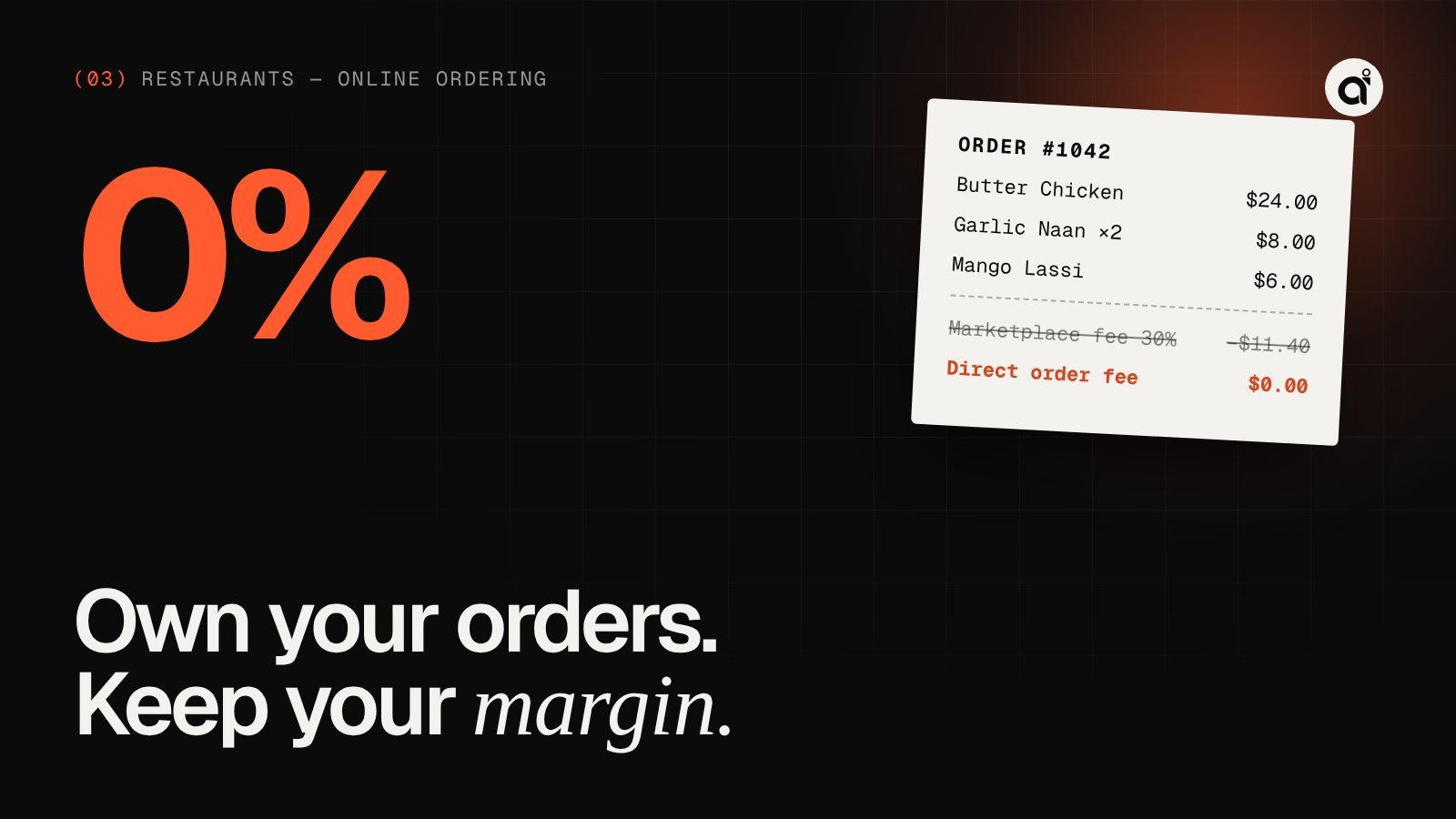
Delivery marketplaces changed how restaurants sell. They also changed restaurant margins. When a large share of every order goes to the platform, a busy weekend can feel less profitable than it should. That’s why more restaurants are launching their own online ordering — not to abandon marketplaces, but to stop paying commission on customers who already love them.
What marketplaces really cost
Commission structures vary by country, plan and contract, but the ranges are consistent:
- In the United States, published Uber Eats marketplace plans as of March 2026 run from 20% to 30% on delivery orders, while DoorDash plans range from 15% to 30%.
- In India, Zomato and Swiggy base commissions are typically around 18–28%, with 18% GST charged on top of the commission itself.
- Advertising, promotions and discounts funded by the restaurant can push the effective cost of an order considerably higher.
On a ₹1,000 or $40 order, that’s a meaningful portion of the margin — repeated on every single order, including orders from regulars who would have ordered directly if it were easy.
The hidden cost: you don’t own the customer
On a marketplace, the customer relationship belongs to the platform. You usually can’t see full contact details, can’t easily invite them back, and compete with nearby restaurants on the same screen. With your own ordering system, every order builds your customer list — and repeat customers become far cheaper to reach.
What a direct ordering system includes
- A fast, mobile-first menu with photos, modifiers, combos and add-ons.
- Pickup, delivery and dine-in ordering, with scheduled orders and trading-hour rules.
- Delivery zones and fees calculated by real driving distance via the Google Distance Matrix API.
- Secure payments with Stripe, eWAY, Razorpay or pay-on-pickup.
- Automatic kitchen printing to Epson ePOS and thermal printers.
- An admin dashboard for orders, menu changes, sold-out items, customers and sales reports.
- SMS, WhatsApp and email updates for customers.
I’ve built systems like this for Moti Mahal Indian Restaurant in Malvern, Victoria and Punjabi Sunrise in Alexandra Hills, Queensland, where online ordering, reservations and sales management run from one platform.
Use both channels — strategically
The smart approach isn’t to quit marketplaces overnight. Think of them as advertising: they bring new customers who haven’t heard of you. Your own ordering system is where you convert those customers into regulars.
- Put your direct ordering link everywhere you control: Google Business Profile, Instagram, your website and receipts.
- Add a QR code to takeaway bags and tables pointing to your own ordering page.
- Offer a small, sustainable incentive for ordering direct — a free side or loyalty points still costs far less than commission.
- Make reordering effortless with an installable PWA so regulars order from their home screen.
What does it cost?
A custom ordering platform is a one-time investment plus modest hosting and payment-processing fees — there’s no commission per order. My restaurant ordering systems start from ₹1,24,999 in India or $3,999 internationally, depending on delivery logic, POS and printer integration, and reservations. For many busy restaurants, the saving on commissions covers the build within months, not years.
Is your restaurant ready?
If you already take a steady volume of online orders — and especially if many come from repeat customers — owning your ordering is one of the highest-return investments you can make. See how online ordering systems work, or book a free call to talk through your numbers.